


Why is coconut oil so popular for makeup removal?
Coconut oil is a vegetable oil rich in fatty acids, mainly lauric acid. This composition gives it an excellent ability to dissolve greasy substances… and therefore makeup.
Specifically, it allows you to:
-
Easily removing foundation, mascara, or lipstick;
-
Respecting the skin's hydrolipidic film;
-
Leaving a soft sensation after cleansing.
It is also a popular ingredient because it is natural and economical. On paper, the arguments are appealing. But in practice, things are a bit more complex...
The benefits of coconut oil for removing makeup
Used occasionally or on certain areas, coconut oil can offer real benefits.
Benefit #1: a formidable effectiveness on stubborn makeup
Thanks to its greasy texture, it quickly dissolves pigments, silicones, and waxes present in makeup products, including waterproof ones.
Benefit #2: an immediate feeling of comfort
Unlike some harsh makeup removers, it does not sting the eyes or cause immediate tightness, especially on dry skin.
Benefit #3: a nourishing action
It can provide a relipidating effect that is interesting for very dry or dehydrated skin, especially in winter. But these benefits should not overshadow its limitations.

Why pure coconut oil can cause problems on the skin?
If coconut oil is natural, that does not mean it suits all skin types or daily use on the face.
A highly comedogenic oil
Coconut oil has a high comedogenic rating. This means it can clog pores, promote the appearance of blackheads, microcysts, and pimples, especially on:
-
The acne-prone skin;
-
Skin prone to hormonal imperfections.
Used alone and regularly, it can therefore unbalance the skin instead of improving it.
A risk of occlusive film
Coconut oil forms a occlusive film on the skin's surface. If it is not properly rinsed or emulsified, it can trap:
-
Makeup residues;
-
Pollution particles;
-
The impurities accumulated during the day.
Result: the skin may feel soft at the moment, but suffocate in the medium term.
An imbalance of the skin microbiota
For some people, coconut oil can disrupt the skin's natural balance, cause redness, small inflammatory pimples, or discomfort sensations, especially on sensitive skin.
Makeup removal with oil: a good idea... under certain conditions
The principle of makeup removal with coconut oil is not bad in itself. On the contrary: it is even recommended by many skin professionals. But it all depends on the formulation.
A pure vegetable oil is not designed to be a complete makeup remover. It contains neither emulsifying agents, soothing actives, nor ingredients designed to be easily rinsed off with water.
This is where the difference between raw oil and a genuine formulated makeup remover becomes essential.
Why is a makeup remover formulated with coconut preferable?
A good makeup remover formulated with coconut retains the benefits of this ingredient while limiting its drawbacks.
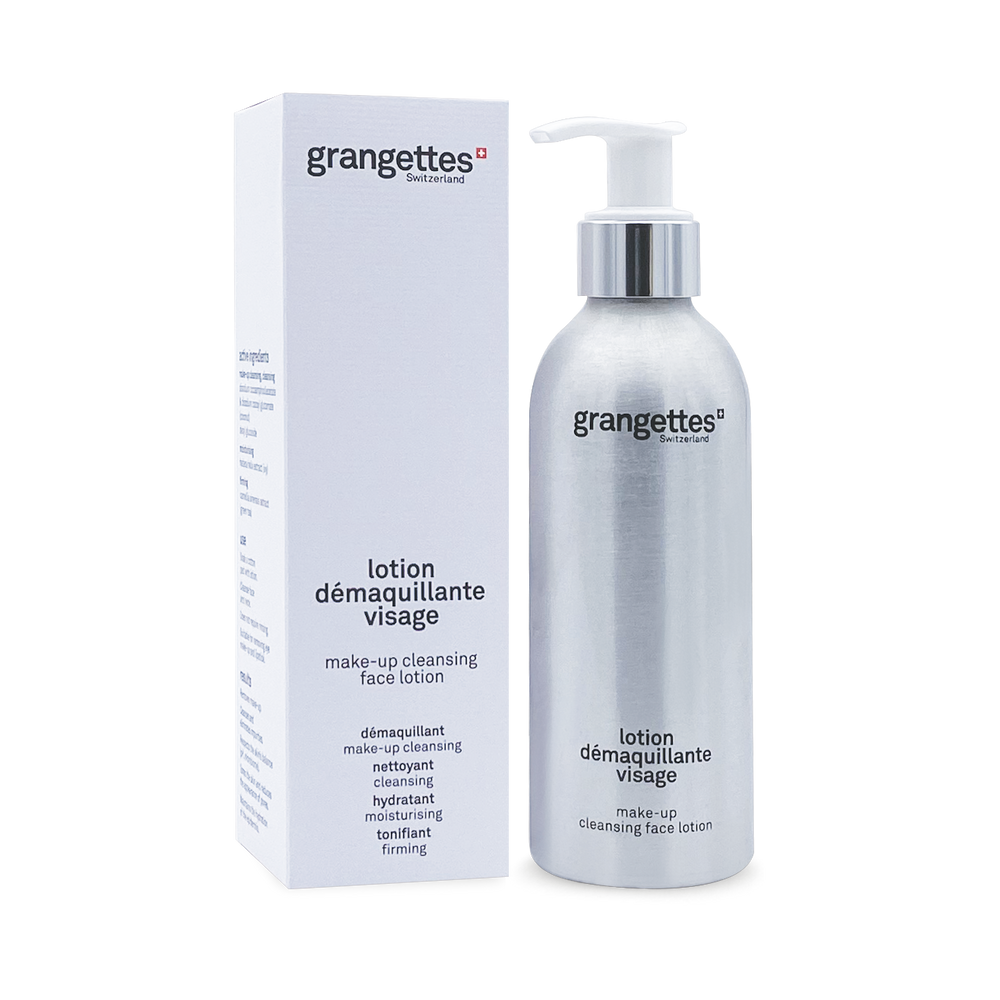
This is the case with the Grangettes Switzerland cleansing lotion, which incorporates coconut in a balanced formula designed for the face.
- Regular price
- 33,30 €
- Regular price
- Sale price
- 33,30 €
- Unit price
- per
Coconut derivatives to cleanse without irritation
In the Grangettes cleansing lotion, no coconut oil is used as is. The formula is based on coconut derivatives, such as disodium cocoamphodiacetate and disodium cocoyl glutamate. These ingredients are obtained from coconut fatty acids but are transformed to fulfill a specific function: gently cleansing the skin without irritating it.
Mild surfactants for the skin
These coconut derivatives act as mild surfactants. Their role is to capture the oily makeup residues and impurities, then make them rinseable with water. Unlike pure coconut oil, they do not remain on the surface and do not form an occlusive film that could clog pores.
Respect for the skin barrier
Another major difference between the Grangettes cleansing lotion and pure coconut oil: their skin tolerance. The surfactants derived from coconut used in the Grangettes lotion are known for their affinity with the skin and their respect for the skin barrier. They provide effective cleansing while limiting tightness sensations, making them suitable for sensitive, reactive, or blemish-prone skin.
Choosing a makeup remover formulated from coconut derivatives, rather than using raw oil, allows you to benefit from:
-
Effective makeup removal;
-
Complete rinsing without greasy residue;
-
Better respect for the skin’s balance.
The difference is not in the origin of the ingredient, but in the cosmetic formulation: it is what transforms a simple natural ingredient into a product truly suited for the face and daily use.

Who can pure coconut oil still suit despite everything?
In certain specific cases, coconut oil can be used with caution:
-
For occasional makeup removal, for example when traveling;
-
On the eyes only, where the skin is thinner and less prone to comedones;
-
On very dry skin, without acne tendency, provided you perform a double cleansing afterward.
How to remove makeup properly without damaging your skin?
To respect the skin’s balance, a few simple rules apply:
-
Favor a makeup remover that is formulated and dermatologically tested;
-
Avoid pure comedogenic oils for daily use on the face;
-
Rinse or emulsify the product properly;
-
Adapting makeup removal to your skin type.
Makeup removal is not just a practical step: it is the first step of skincare, the one that determines the long-term health of the skin.
Verdict: coconut oil alone or coconut makeup remover?
Removing makeup with coconut oil is not a bad idea in itself, but its pure and daily use can cause side effects: clogged pores, blemishes, skin imbalances.
Choosing a makeup remover like the one from Grangettes Switzerland, which contains coconut derivatives integrated into a balanced formula, allows you to enjoy its benefits without suffering the drawbacks. The difference lies less in the ingredient than in the formulation!
When it comes to skin, natural always benefits from being… well formulated.